
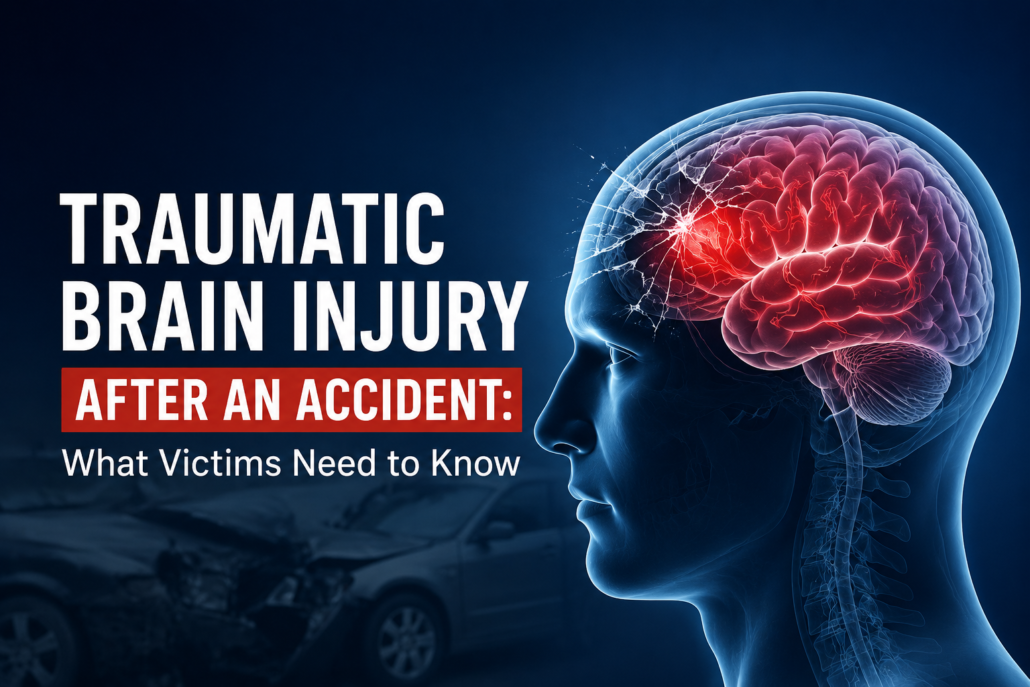
Traumatic Brain Injury After an Accident: What Victims Need to Know
A fall, a car accident, or a blow to the head, and in the moments after, everything feels like a blur. Maybe you walk away feeling fine, only to develop headaches, memory problems, or unexplained fatigue hours or days later.
Traumatic brain injury doesn’t always announce itself right away, and that’s exactly what makes it so dangerous both medically and legally. Insurance companies often use this delay to question whether the injury is related to the accident, reducing or denying the compensation victims deserve.
If you or someone you love is dealing with TBI, you are not alone. You don’t need to navigate the process without assistance. In this guide, we describe what you need to do in this situation, from recognizing your warning signs to understanding your legal rights and the potential value of your case.

What Is a Traumatic Brain Injury After an Accident?
A traumatic brain injury (TBI) is an injury to the brain caused by an external force, such as a blow, bump, jolt, or penetrating injury to the head. But not all blows and jolts cause a TBI. When an object enters the brain tissue, it can cause a TBI.
Some TBI types are temporary and disrupt your brain functions for a short time. These could be how a person thinks, moves, communicates, and acts. But severe TBIs can lead to permanent or long-term issues, or a person can even die.
The effects of brain trauma generally occur in two stages: primary injury and secondary injury. Primary injury occurs at the moment of impact. Secondary brain injury develops over hours, days, or even weeks after the initial trauma. It results from biological processes such as swelling, reduced blood flow, inflammation, and increased pressure inside the skull, which can worsen the original injury.
TBI is divided into two major types:
- Penetrating TBI: This is an open TBI that happens when an object creates a hole or goes into your skull, such as a bone fragment, shrapnel, or a bullet that enters the brain tissue. It typically damages the area of the brain where the object penetrates.
- Non-Penetrating TBI: A non-penetrating TBI is a blunt/closed TBI that damages a part of your brain. It usually occurs when something hard hits your head enough that your brain bounces or twists around inside your skull. These include motor vehicle crashes, falls, blast injuries, sports injuries, or being struck by an object.
What Types of Accidents Commonly Cause Traumatic Brain Injuries?
A violent whipping motion of the neck or a sudden forceful impact to the head can cause a TBI. Several types of accidents are as follows.
- Car accidents
- Truck accidents
- Motorcycle accidents
- Pedestrian accidents
- Bicycle accidents
- Workplace accidents
- Slip & fall accident
Car Accidents
A serious head injury can occur when a person’s head strikes the steering wheel, dashboard, or window during a collision or from a whiplash motion that shocks the brain inside the skull. Even a slow-speed collision can cause concussions or severe brain trauma. Victims may benefit from speaking with an experienced car accident lawyer to understand their legal options.
Truck accidents
Due to the extreme weight of trucks, accidents involving them often result in severe collisions that cause high-impact or catastrophic TBIs. These cases are often more complex than standard car accident claims, which is why many victims consult a truck accident attorney to investigate all potentially liable parties.
Motorcycle accidents
Motorcyclists have very little protection: no seat belt, no airbag, and no metal frame around the body. As a result, riders face a higher risk of head, neck, and brain injuries, even when wearing a helmet. Legal liability typically rests with the at-fault driver, though bias against motorcyclists can complicate these cases. A motorcycle accident attorney can help protect an injured rider’s right to compensation.
Pedestrian Accidents
Pedestrians have no protection from the impact of a vehicle. Pedestrians have virtually no protection from the force of impact, making head and brain injuries especially common.
That’s why these accidents are so serious, sometimes resulting in a skull fracture or a penetrating injury such as a piece of glass or metal. Usually, the driver of the vehicle is at fault for an accident. A pedestrian accident attorney can help determine liability and pursue compensation after a serious collision. In such cases, the law of “comparative negligence” applies.
Bicycle Accidents
Cyclists are at the same risk as pedestrians. They are not protected. The additional risk is that they may fall off the bicycle after impact and suffer a separate head injury. This accident can be caused by a vehicle (driver’s fault), or by a bad road (pothole, uneven surface) (city/municipal street), or by the negligence of another third party. Therefore, liability depends on the cause of the accident; it is not always the driver. A bicycle accident attorney can help identify all available sources of compensation.
Slip and Fall Accidents
Slip and falls are also leading causes of TBI, especially for children and older people. It causes your head to hit a hard surface after slipping on a wet floor, uneven pavement, or poorly maintained stairs. In this case, the liability remains with the property owners or the business under premises liability laws. A slip and fall attorney can help injured victims hold negligent property owners accountable.
Workplace Accidents
Workplace TBIs are usually caused by falls, falling objects, machinery, or vehicle accidents.
Injured employees are generally eligible for workers’ compensation benefits regardless of who caused the accident. If a third party contributed to the injury, the victim may also have a separate personal injury claim.
What Symptoms of a Traumatic Brain Injury Should You Never Ignore?
Symptoms of TBI (Traumatic Brain Injury) can sometimes appear immediately or sometimes even a few days later; this is what makes it so dangerous. Common symptoms of a traumatic brain injury include:
Physical Symptoms That Show on the Body
- Headache
- Vomit/Nausea
- Dizziness, loss of balance
- Unequal pupil size
- Clear fluid or blood coming from the ears or nose
- Excessive sleepiness or difficulty waking up
- Seizures
- Weakness or numbness in the arms or legs
Cognitive Symptoms (The Impact On Brain Internal Function)
- Confusion or disorientation (not knowing where you are, what day it is)
- Memory loss, not remembering things before or after the accident
- Difficulty concentrating, finding even simple tasks difficult
- Slurred speech
Emotional/behavioral symptoms
- Sudden mood swings, irritability, or anger
- Signs of anxiety or depression
- Personality changes: a previously calm person suddenly becomes aggressive

How Do We Know It’s Serious?
Signs that the injury may be serious include:
- Loss of consciousness
- Worsening confusion
- Persistent memory problems
- Significant behavioral changes
Important Legal + Medical Point
Many people feel “fine” right after an accident. There are no visible bruises and no bleeding, but 48-72 hours later, symptoms surface. That’s why doctors say a prompt medical check-up is essential after an accident, even if there are no symptoms, because TBIs often have a delayed onset.
What Should You Do After Suffering a Traumatic Brain Injury in an Accident?
After suffering a traumatic brain injury, you need to seek immediate medical care. Be evaluated immediately by emergency responders without any delay because the longer you wait, the more it can damage your health. Take strict cognitive rest for up to the first 48 hours, avoid screen time and loud noise, and skip difficult tasks.
Also, skip playing sports, heavy lifting, or returning to the job until cleared by the doctor. This practice helps you to protect yourself from sustaining a second injury to your brain. It is very important because a second injury to an unhealed brain can cause long-term consequences.
Another important thing is to take only the medications that are recommended by your doctor. Completely stop using non-prescribed sleeping aids and alcohol until you resume your normal activities.
If your TBI resulted from a workplace accident or was caused by a motor vehicle, gather your evidence. Call the authorities and maintain an organized file of all medical records. In this case, a personal injury lawyer can help you assert your legal rights and navigate insurance claims.
How Is Liability Determined in a Traumatic Brain Injury Case?
Determining liability in a traumatic injury requires proving that another party’s negligence caused the accident and your resulting injuries. This involves showing that the at-fault party has failed to perform their care and responsibility and that this failure led to the harm suffered.
So let’s explore the top liability types that allow you to identify your case complexities.
General Negligence Liability
General negligence liability applies when a party fails to fulfill their duty of care, and someone suffers harm/injury as a result of the negligence; they are legally liable. If a person wants compensation, he needs to prove 4 things to be liable: duty, breach, causation, and damages. This is a general/catch-all legal principle that is the basis for all types of personal injury cases (whether a car accident or otherwise).
Comparative Negligence Liability
Comparative negligence simply means that if the victim is at fault in an accident, the amount of compensation may be reduced based on the victim’s percentage of fault. For example, if you are 20% at fault, your claim will also be worked out at 20%. Each state has its own law, even if you are at fault, you still get something. Sometimes you get more; sometimes you get more than 50% at fault, but you get nothing. Insurance companies try to take advantage of a flaw and put more blame on the victim. Even if it is a mistake, it is important to have a good lawyer who can establish this fault fairly.
Strict liability claims
In this case, it is not essential to prove that the other party was “at fault” or negligent. It is enough to show that the damage occurred and that it was caused by a specific thing/action; the party does not need to prove negligence.
This is most commonly applied in cases involving defective products and dangerous animals. For example, victims injured in a dog attack may have grounds for a claim with the help of a dog bite attorney.
Vicarious Liability Claims
Sometimes one party can be held liable for the fault of another person, even if they were not at fault. This is common in employer-employee relationships. For example, if an employee causes an accident while on the job, their employer may also be legally liable because the employee was driving on “company business.” Trucking companies can be held liable for the fault of their drivers or businesses for the negligence of their employees. This principle is important because, to compensate victims, we need not limit ourselves to the person who actually caused the accident. Companies, however, with more resources and insurance coverage, can also be targeted.
What Evidence Can Help Prove a Traumatic Brain Injury Claim?
Proving a traumatic brain injury claim generally requires strong medical documentation, including records and reports from treating physicians. In many cases, imaging such as a CT scan or MRI is used to detect organic brain injuries. However, not all TBIs show up on imaging; brain injuries can range widely in severity and may not always produce visible physical evidence, making other forms of proof, such as symptom documentation and expert evaluation, equally important.
Medical Records
Medical records are the foundation of a TBI claim that indicate injury progression and ongoing injury needs. These are the records that document the diagnosis, severity of brain injury, and treatment.
Accident Reports
Accident reports include police and incident reports that are essential to determine how the accident or injuries occurred and to identify the fault. These records help to establish the circumstances that led to that injury.
Witness Statements
People who actually saw the accident happen can back up your version of events in a way that carries real weight. Their statements help confirm what happened and who was responsible.
Expert Testimony
Sometimes you need a specialist, a doctor, or an accident reconstruction expert to explain exactly how the injury happened and what it means for your future. This kind of testimony can make a huge difference in connecting the dots for a judge, jury, or insurance company.
What Compensation Can You Recover After a Traumatic Brain Injury?
After a TBI injury, compensation can be recovered for both tangible and intangible losses. These could be economic, like current or future medical bills, rehabilitation costs, and lost wages. Besides, it also contains non-economic losses such as suffering, pain, and loss of enjoyment of life.
Severe traumatic brain injuries are often classified as catastrophic injuries because they can permanently affect a person’s ability to work, communicate, and live independently.
Medical Expenses
Compensation includes all the medical costs related to the accident, such as hospital bills, medication, rehabilitation, surgery, and therapy. This covers both past and ongoing expenses.
Lost Wages
If the victim was unable to go to work due to a hunting injury (during recovery), we can claim a loss of income during the working days/weeks he was away from work.
Reduced Earning Capacity
This is slightly different from lost wages. If the injury permanently affects the victim’s ability to earn the same income in the future, compensation may be awarded for reduced earning capacity.
Pain and Suffering
This is non-economic damage, meaning physical pain, emotional distress, mental anguish, and the negative impact on overall quality of life, which is also compensated for. There is no fixed bill for this; it is calculated on a case-by-case basis.
Future Medical Care
If the TBI is ongoing or requires lifelong treatment, such as therapy, follow-up surgeries, or ongoing care, the expected future costs to us are also estimated and included in the compensation claim.
Additional Compensation That May Be Available
Besides the medical and lost income compensation, TBI patients are often eligible for compensation for losses that cannot be put a number on but are just as real.
Loss Of Enjoyment Of Life
If your brain injury did not allow you to spend your life as before the accident, such as spending time with family or friends, going out, playing sports, or anything that brought you joy, that loss matters. It is something you can be compensated for.
Emotional Distress
TBI is not just a physical injury. Many people are struggling with depression, anxiety, PTSD, or frequent mood swings that they never had before an accident. These emotional effects are genuine damages and may be included as part of your compensation claim.
Home Modification
Some damages are so severe that your home needs to change with you. Home modifications, such as wheelchair ramps, accessible bathrooms, widened doorways, and other accessibility improvements, may be recoverable damages. Those costs should not fall on you.
In-Home Nursing Care
In-home nursing care is also factored into your compensation. It includes that you need help with everyday things now, like basic personal care, getting around, and managing medication.
Loss of Consortium
A severe brain injury not only affects you, but it also changes your relationship with your family and spouse. When that companionship, connection, or support is affected, the law recognizes it as a real loss.

Permanent Disability
When the effect of TBI becomes permanent, whether it’s emotional, physical, or cognitive, you deserve compensation. It reflects what the rest of your life will actually look like, not just what you have dealt with so far.
Contact Us Today for a Free Consultation
A traumatic brain injury can change a person’s life instantly. Navigating the legal process while trying to recover should not add to that burden. If you are dealing with lost income, increasing medical bills, and an insurance company that didn’t take your case seriously, you are not alone.
At Cockayne Law, we understand the emotional, physical, and financial costs that a TBI can inflict on you and your family. Our professional team helps victims to secure the compensation they deserve. Besides, we handle all the cases on a contingency fee, so there are no fees if there is no win.
The timeline is limited to filing a case, so the sooner you speak with the attorney, the better your rights will be secured. Contact us today for a free and no-obligation consultation. Let us help you to take your first step toward your recovery and justice.

Chris Cockayne is a Utah-based personal injury attorney and the founder of Cockayne Law. Chris focuses exclusively on representing victims of car accidents, dog bites, and other injury claims, helping clients recover compensation for medical bills, lost wages, and long-term care. With over 15 years of legal experience, Chris has handled a wide range of personal injury and motor vehicle accident cases and is known for his client-focused advocacy and strong negotiation with insurance companies. Know more about Chris Cockayne or my other social profiles like Avvo | Martindale | lawyers | Findlaw | Yelp | lexinter | Linkedin | Facebook | and X
This post is also available in: