
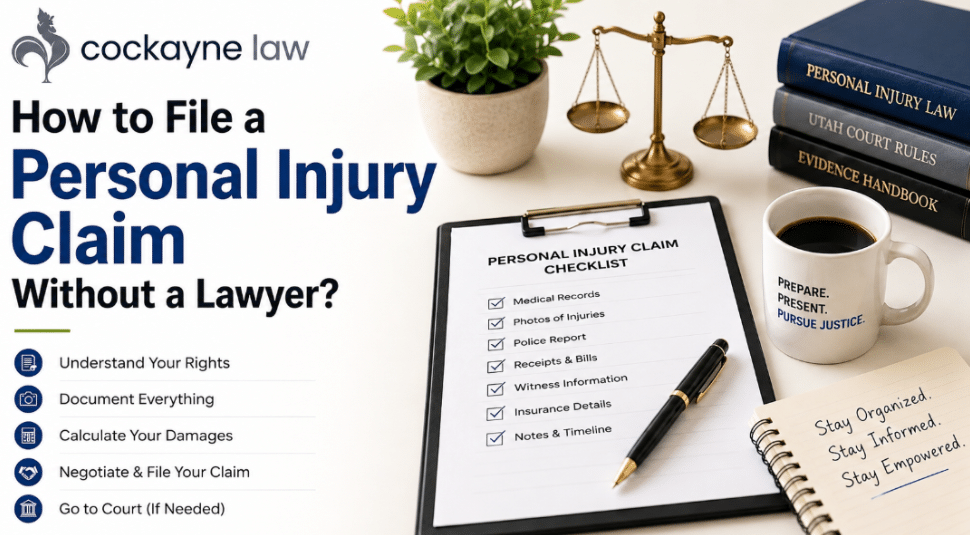
How to File a Personal Injury Claim Without a Lawyer?
/in Personal Injury Lawyer, Resource/by Chris CockayneOne bad moment (a rear-end tap, a loose handrail, or a toppled shelf) can leave you hurt and worried about bills. Legal help costs money you may not have, and understanding a personal injury lawyer’s fee structure can ease concerns, yet letting an insurance company decide your future feels risky.
Table of Contents
ToggleUtah rules give injured people a fair shot at handling smaller claims on their own, as long as deadlines are met and paperwork is neat. This guide walks you through each stage in plain language, using local court figures and real filing rules.
You will see the benefits of do-it-yourself action, the common traps, and the point where handing the file to Cockayne Law makes sense. Be sure to note the following: steady preparation often beats deep pockets in minor cases.
Can You Make a Personal Injury Claim Without Legal Counsel?
In Utah, individuals can submit a personal injury claim without an attorney, especially when the case is simple and pertains to minor injuries or property damage. Many choose to negotiate directly or utilize small claims court for their claims related to auto accidents, slip and fall cases and minor insurance disagreements.
However, having legal representation is crucial in cases involving severe injuries, contested liability, long-term disabilities or delays from insurance companies. It is important to keep all medical records and invoices organized.
- Take photos of injuries and property damage
- Respond to insurance companies carefully
- Track deadlines and court paperwork
- Avoid accepting the first settlement offer
What You Need to Know Before Filing a Personal Injury Claim Yourself
Here are some important things to understand before filing a personal injury claim on your own.
Know How Fault Cuts Awards
Utah follows a modified comparative negligence system. If it is found that you are 50% or more responsible for the accident, you will not qualify for compensation. On the other hand, if your responsibility is below 50%, your compensation will be reduced by that percentage.
Insurers use this rule to their advantage, often arguing that you looked down at your phone, missed a warning sign, or had worn tires. Keep photos, weather records, and witness statements that reduce your share.
Pick the Right Courtroom
Under the new update, small-claims judges will hear disputes up to $20,000, including attorneys’ fees; they do not include costs and interest. If your claim is over $20,000 or involves more intricate legal matters, it might be necessary to submit it to the district court.
Small claims moves faster, limits discovery, and caps delays. The district court gives the defense more tools (motions, interrogatories, and experts) that can overwhelm a solo plaintiff, yet are needed if hospital bills alone exceed the cap.
Budget for Filing and Service
Current filing fees sit at $60 for claims up to $2,000, $100 to $7,499, and $185 from $7,500 to $20,000. Service by a sheriff or constable averages $50 per address, rising for rural runs. If you cannot afford the fee, Utah courts allow a waiver request called an affidavit of impecuniosity.
Mind Insurance and PIP Rules
Utah uses a no-fault insurance system for auto accidents. Personal Injury Protection pays for the first $3,000 in medical expenses irrespective of fault. You have to surpass that amount or hit a statutory injury threshold (fracture, disfigurement, or at least 60 days of disability) to sue the driver.
Save all PIP explanation of benefit forms so the judge knows why you pushed through the gate and how much PIP has already paid.
What Types of Cases Can Be Settled Without Hiring a Personal Injury Lawyer?
Not every mishap needs a car accident attorney SLC or tort law attorney. Many Utah residents resolve modest claims themselves when injuries heal quickly, fault is obvious, and total losses fall under the small-claims ceiling.
Less complex injury claims can often be managed without a lawyer, particularly when liability is evident and the damages are minimal.
Below are common examples, with proof you should gather for each.
Case Type | Why DIY Often Works | Key Evidence |
Fender-bender at the rear, light damage | Fault seldom disputed | Police report, bumper photos, repair bill |
Low-speed parking-lot hit | Cameras capture the incident | Store security clip, witness names |
Minor slip and fall in the store | Visible hazard, limited care | Incident log, spill photo, urgent-care note |
Dog nip, small wound | Strict owner liability | Animal control record, vaccine proof |
Bike vs. open car door | Clear traffic rule breach | Helmet cam clip, EMT bill |
Product cut or bruise | Recall records help leverage | Receipt, photo of defect, stitch cost |
Property damage only | No bodily injury debate | Mechanic’s estimate, valuation guide |
Car and motorcycle accident attorneys or catastrophic injury attorneys can help with severe injuries. It includes spine surgery, brain trauma, and wrongful death.
Step-by-Step Process to File a Personal Injury Case Without a Lawyer
Handling your claim is like finishing a home repair: measure twice, cut once, and work in order. Essentially, the goal is to prove someone violated a safety rule, that breach caused you harm, and that harm is what gives you fair compensation to make yourself whole.
Follow these steps to file the case.
Step 1 – Confirm Deadlines and Venue
Start by writing down the injury date, then count 4 years forward. Set a reminder in your phone calendar six months before that day. If a city truck, school district, or state agency caused the harm, file a written notice of claim within one year, then wait at least 60 days before suing.
Pick your court next. For any claim under $20,000, small-claims court is faster and friendlier. Locate the correct justice court by county. Print the “Small Claims Affidavit and Summons” from the Utah courts site, fill it in with ink, and list the exact dollar amount, not “TBD.”
Filing fees scale with claim size. Bring two extra copies for the clerk’s stamp—one is for personal service on the defendant.
Step 2 – Alert Insurance Early
Most auto and homeowner policies say the insured must notify the carrier promptly, especially before they file a car accident claim. A simple letter stating the date, place, and parties preserves coverage. Send it by certified mail if the other driver will not report. For your own PIP or MedPay benefits, open a claim right away, then forward medical bills as you receive them. Fast notice lets adjusters set reserves and prevents later denials for “late reporting.”
Step 3 – Gather and Guard Evidence
Gather evidence quickly because photos, records, surveillance footage, and witness statements become harder to obtain over time. Start a physical folder and a cloud folder. Copy every medical record, even routine X-ray notes, after finding the right doctor after a car accident in Utah. Ask treating doctors for a short statement linking the injury to the event. Take scene photos from multiple angles, with a ruler or coin next to hazards to show scale. Print weather data from the National Weather Service if rain or snow mattered. Record witness contacts quickly because memories fade. A personal injury lawyer West Jordan checks public feeds and can subpoena private posts.
Step 4 – Calculate Damages
Total your medical bills, therapy costs, and prescription receipts. Add lost wages by multiplying missed hours by your regular rate and attach pay stubs. Utah courts accept mileage to medical visits at the IRS medical rate.
For pain and suffering, start with one to three times the medical bills for modest injuries. Use the lower end for a sprain that heals in weeks and a higher figure for months-long discomfort. If you will need future care, request your doctor’s written estimate and keep receipts for adaptive equipment. Record all sums in a spreadsheet that updates automatically.
Step 5 – Draft a Demand Letter
Aim for two pages. Start with a short recap: what happened, why the insured is at fault, and how you were hurt. List each bill in a one-column table with dates and amounts. State your total demand, then write “This demand remains open for 30 days.” Attach key proof: top medical bill, wage-loss letter, and scene photo. Certified mail provides proof that the insurance company received your demand letter.
Step 6 – Negotiate With the Adjuster
Expect a call or letter. The first offer often ignores pain and damage. Do not accept on the spot. Thank the adjuster, ask for the offer in writing, and note the reasons given. Prepare a counteroffer backed by bills and your journal entries. Negotiate with the adjuster using proven advice from car accident lawyers and offer tips on talking to insurance adjusters.
Stick to facts and use dollar figures, not round guesses. If fault is questioned, walk through Utah’s 50-percent rule and show why your share is low. Log every conversation: date, time, and highlights.
Common Mistakes When Managing a Claim Yourself
Many self-represented injury claims lose value due to avoidable mistakes, such as giving recorded statements too early, missing medical appointments, accepting the first settlement offer, or failing to properly document injuries. Maintaining organization and thorough records can enhance your claim.
Step 7 – File Suit When Talks Stall
Consider mediation in personal injury cases before heading to court. If the settlement lags past a reasonable time or the final offer stays below expenses, file. In small claims, take the completed affidavit and fee to the justice court clerk. The clerk sets a hearing, usually within two months. Hire a sheriff, constable, or licensed server to hand papers to the defendant; Utah bars personal service by the plaintiff. File proof of service with the court. The defendant has 21 days to answer or risk default. District court filings are more complex: you must draft a complaint, pay a higher fee, serve under Utah Rule 4, and possibly face deposition in personal injury cases. Use plain language and attach your main exhibits to the complaint if they are short.
Step 8 – Present Your Case
Arrive early on hearing day, dress modestly, and bring three sets of exhibits. When the judge calls your case, stand, state your name, and hand one set to the clerk. Your opening should cover duty, breach, cause, and damages in under three minutes. Use simple words: “She ran the red light and hit me.” Show photos, mark them as exhibits, and briefly explain each. When finished, ask the judge for the amount on your affidavit, plus filing fees and interest.
Step 9 – Collect the Judgment
If you win, the court issues a judgment. Ask for a certified copy. The defendant may pay within days, but if not, file a “Notice of Judgment Lien” with the county recorder and send a demand letter. Wage garnishment requires a motion and writ; banks need a writ of execution.
Signs It May Be Time to Speak With a Personal Injury Attorney
Some minor injury claims can be resolved without legal representation, but more complex situations typically require assistance from a skilled attorney. Insurance companies might try to pay less, argue about who is at fault, or pressure injured people into accepting low settlements that don’t cover all their losses.
A lawyer can help you figure out how much your claim is worth, collect evidence, negotiate with insurance companies, and protect your rights during the process.
Consider consulting a personal injury attorney if:
- You are dealing with significant injuries that require continuous medical treatment.
- The insurance company denies, delays, or offers too little for your claim.
- There is a conflict regarding who is liable for the accident.
- Several people might be at fault for your injuries.
- You can’t work and have lost income.
- You may need future medical treatment or long-term rehabilitation.
- The settlement offer doesn’t seem to cover your damages.
- The accident caused permanent disability or significant impairment.
Getting legal advice early can help preserve important evidence, avoid costly mistakes, and ensure you understand your options before making decisions that could impact your recovery.
Risks of Handling a Personal Injury Claim Without a Lawyer
Saving a fee feels good until a single mistake costs thousands. Here are the major hazards solo claimants face.
- Late filing – Miss the statute, lose the case.
- Wrong defendant – Sue the LLC instead of the parent company.
- Venue error – File in the wrong county, restart later.
- Low valuation – Forget future therapy costs.
- Recorded slips – Adjuster twists an off-hand remark.
- Evidence fades – Surveillance footage erased after 30 days.
- Fault inflation – Defense persuades the judge you are 51 percent at fault.
- Lien surprises – Health insurer demands repayment after settlement.
- Expert gap – Need an engineer, but cannot pay.
- Collection hurdles – Winning paper, yet no payment.
- Stress and recovery – Legal worry slows healing.
- Insurer delay tactics – Adjuster runs out the clock.
Although each risk can be managed with care, knowing when to hire a personal injury lawyer becomes important when these issues start piling up.
Final Thoughts
Utah gives injured residents a fair chance to handle modest claims alone. Meet every deadline, keep proof tidy, and state your numbers with confidence. Small claims court is designed for citizens, not just lawyers.
Still, once medical bills grow, injuries become long-term, or fault is disputed, choosing a personal injury lawyer on a contingency fee basis and knowing what percentage a personal injury lawyer takes can protect your rights and lift the burden.
Related Helpful Post: Tips to Talk to a Personal Injury Lawyer
FAQ - Frequently Asked Questions
How do I win a personal injury case without a lawyer?
Present organized evidence, prove the defendant’s fault is under Utah’s 50 percent bar, and support every dollar with a bill or pay stub.
What if the insurance company blames me?
Collect photos, weather data, and witness statements that reduce your share of blame. Even a small shift below 50 percent keeps the claim alive.
How long does an insurer have to respond to a demand letter in Utah?
While no statute sets a firm period, giving the carrier 30 days in your letter is standard and considered reasonable.
What happens if the defendant ignores the judgment?
File for wage garnishment, bank levy, or a property lien. Interest accrues until paid, and the judgment is enforceable for eight years, renewable once.
Can I resolve a claim for a car accident without an attorney?
Absolutely. Many smaller car accident claims in Utah are settled without the need for a lawyer, particularly when injuries are minimal and liability is evident. Maintaining organized medical documentation, repair quotes, photographs, and correspondence with the insurance provider can increase your chances of obtaining a fair settlement.

Chris Cockayne is a Utah-based personal injury attorney and the founder of Cockayne Law. With over 15 years of legal experience, Chris has handled a wide range of personal injury and motor vehicle accident cases. He writes about personal injury law, motor vehicle accidents, insurance claims, and related legal issues.
Know more about Chris Cockayne or my other social profiles like Avvo | Martindale | lawyers | Findlaw | Yelp | lexinter | Linkedin | Facebook | and X
This post is also available in: Spanish