
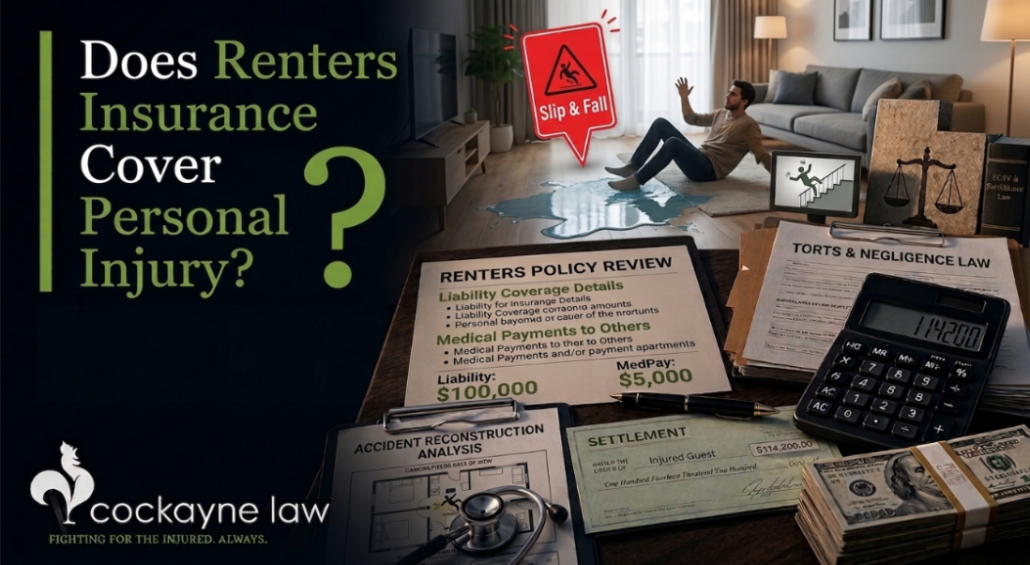
Does Renters Insurance Cover Personal Injury?
/in Blog/by Chris CockayneYes, but it depends on what you mean by “personal injury.” Renters insurance may cover injuries to guests when you are legally responsible through personal liability coverage, and some policies provide medical-payments coverage for guests regardless of fault. It generally does not cover your own bodily injuries. In insurance policies, “personal injury” can also refer to non-physical harms such as defamation or invasion of privacy, which may require specific coverage.
Table of Contents
ToggleThe bills have already arrived, and only now are you finding out whether renter’s insurance would have paid. A guest ER visit after a fall in your apartment? You can recover it if you are legally responsible.
Your own fall? No. Your roommates? Usually not. And if the fall happened because your landlord ignored the broken step, the answer changes again. This guide covers each situation where the coverage stops and what Utah law adds when a landlord is at fault.
What Does “Personal Injury” Mean in Renters Insurance?
In renters insurance, there are two different aspects, and many people are confused about both. A personal injury is a physical injury, such as a dog bite, a slip-and-fall, or a severe burn. Insurance companies call that a bodily injury.
When a renter’s policy uses the term “personal injury,” it means something else entirely, like harm to a person’s reputation or rights, such as defamation or invasion of privacy.
Someone can sue you for either. Your policy may respond to both, one, or neither, depending on what you bought.
Bodily Injury vs. Personal Injury
Bodily injury | Personal injury (insurance meaning) | |
What it is | Physical harm to a person | Non-physical harm to reputation, privacy, or personal rights |
Examples | Slip and fall, dog bite, burn | Libel, slander, invasion of privacy, false arrest, malicious prosecution |
Typical claim against you | A guest is hurt, and you’re legally responsible. | Someone says what you said or posted harmed them |
Where it sits in your policy | Personal liability and medical payments to others | Personal injury endorsement, or sometimes inside liability |
Usually included? | Yes, for guests (not for you or people who live with you) | Varies by insurer, often optional |
What Happens When a Guest Gets Hurt in Your Rental?
When a guest gets hurt in your rental, two policy types apply. Many people mix them up, but these policies work differently.
Personal Liability Coverage
Personal liability coverage helps when a guest says you are at fault, demands payment, and files a lawsuit. If you’re legally responsible, it can pay their medical costs and settlement. If it turns into a lawsuit, your insurer can also cover your defense, up to your limit.
But someone getting hurt in your home doesn’t automatically make it your fault. It usually comes down to whether you were careless or left a hazard you knew about, like a loose stair or a spill you never wiped up.
Medical Payments to Others
Medical payment coverage is smaller and simpler. It pays a guest’s immediate medical bills, such as an ER visit or an X-ray, whether or not anyone blames you.
It helps settle small injuries quickly before they become a claim. It applies to guests only, not to you or people who live with you.
Typical Coverage Limits
Personal liability | Medical payments to others | |
Pays for | Medical bills, settlements, legal defense | A guest’s immediate medical bills |
Do you have to be at fault? | Yes | No |
Typical limit | $100,000 to $300,000 | Much lower, often a few thousand dollars |
Does Renters Insurance Cover Dog Bites?
A dog bite claim gets expensive. The national average cost per dog-related injury claim was $65,450 in 2025, according to the Insurance Information Institute and State Farm. Renters’ policies cover those claims.
When Dog Bite Injuries May Be Covered
If your dog bites a guest, a neighbor, or a stranger on a sidewalk, your personal liability coverage usually responds. It can pay the victim’s medical bills, and if they sue, your legal defense, up to your limit.
Liability coverage generally follows you, so it matters less whether the bite happened in your apartment or the park. Utah adds something people don’t expect. Under Utah Code § 18-1-1, an owner is generally liable for a bite even if the dog has never hurt anyone before.
Simply saying “he’s never done this” isn’t enough to help. What matters is whether your policy covers it and whether your limit is high. Typically, limits run $100,000 to $300,000, and nothing above that comes out of your pocket.
Dog Breed and Animal Exclusions
Insurers don’t treat all dogs the same way. Some charge more for breeds like pit bulls and rottweilers. Some exclude certain breeds, and a few won’t insure dog owners at all.
Others ask you to sign a bite waiver or will cover a dog that has been through behavior training or is kept muzzled or caged.
If your policy excludes your dog breed, a bite can leave you paying the whole bill yourself. So read the animal exclusion before you renew and tell the insurer about your dog.
Leaving a pet off your application can get a claim denied, and in some cases the policy itself can be avoided.
What If You Are the One Who Gets Hurt?
Renter’s insurance is meant to protect others from you, not to protect you from your own accidents. It means if you slip on your own floor or bathroom or trip over your own rug, your liability coverage does not apply, because there is no one to sue.
Your own medical bills go through your own health insurance, not your rental policy. The one exception is your personal property coverage, which still applies if the same incident damages your stuff, say a fall that also broke your laptop.
Who Pays?
Who got hurt | Who’s at fault | What typically pays |
A guest | You (or a hazard you ignored) | Your renters insurance (liability or med pay) |
A guest | No one, pure accident | Medical payments to others, if included |
You | No one else involved | Your health insurance, not renters insurance |
You | Landlord’s negligence (broken stair, faulty wiring) | Landlord’s liability insurance, or a claim against the landlord |
A roommate or family member living with you | You | Usually excluded; renters liability doesn’t cover people who live with you |
A roommate or family member living with you | A guest, or a hazard neither of you caused. | May be covered, similar to a guest claim |
Injuries to Roommates and Household Members
Roommates complicate things, but not for the reason most people assume. It’s not that a roommate’s claim uses up some shared limit. Liability coverage only protects you from people outside your household.
Someone you lived with usually is not covered unless they are named on your policy. So if your roommate gets hurt because of something you did, they may not be able to file a claim unless they have their own policy.
That’s why insurers recommend separate rental policies for unrelated roommates, not shared ones.
Injured Because of Your Landlord’s Negligence in Utah
If you are injured because your Utah landlord failed to address a dangerous condition, the claim may be against the landlord rather than through your renters insurance.
Utah Code § 57-22-4 makes landlords responsible for keeping rentals safe, including stairs, wiring, plumbing, and heat. A known hazard left unfixed is what a negligence claim is built on.
Utah splits fault under § 78B-5-818. Under 50% fault, you still get paid, just less. At 50% or more, you get nothing. § 78B-2-307 gives 4 years to file. Report hazards in writing.
What Does Renters Insurance Not Cover?
Liability coverage has limits too. A few situations fall outside it no matter how high your policy limit is.
Intentional Acts and Business Activities
If you hurt someone on purpose, your policy won’t pay. Insurance covers accidents, not intent. The same goes for anything tied to a business you run from home.
If a client trips in your apartment while picking up an order for your Etsy shop, that claim is usually excluded. A small fall involving a regular guest, however, would be covered.
Some insurers sell a business use endorsement for exactly this gap.
Vehicles and Motorized Equipment
A guest hurt by your car, moped, or golf cart is not a renters insurance claim that goes through your auto policy instead. This trips people up because the accident can still happen right outside your apartment.
If your kid’s electric scooter clips a neighbor in the parking lot, whether it’s covered depends on the vehicle, not the location.
Misrepresentation on Your Application
Insurers ask about pets and sometimes about who lives with you. Leave a dog off the application, or leave a roommate off it, and a claim tied to either one can be denied.
In some cases, the insurer can avoid the whole policy, not just that claim. Update your application when your household changes.
Common Scenarios: Who Pays First?
These are hypothetical examples, not real claims, meant to show how coverage plays out in practice.
A friend trips over your cord and breaks a wrist.
Your personal liability coverage responds if you are found responsible, typically up to $100,000 to $300,000 depending on your policy. Medical payment coverage may pay smaller bills right away, before fault is even decided.
Your dog bites a neighbor’s kid at the park.
Liability usually follows you off the property, so the location doesn’t rule out coverage. What decides it is your dog breed and whether the claim stays under your limits. Dog bite claims averaged $65,450 in 2025.
You slip in your own shower and break your wrist.
No renters insurance claim here. No one else is liable, so it runs through your health insurance instead.
Your roommate falls down the stairs because you left a box on the landing.
If your roommate is not named on your policy, they may not be treated as a covered claimant the way a guest would be. Recovery often depends on the specific policy and on whether they carry their own renters insurance.
A loose railing your landlord never fixed gives way, and you fall.
Not a renters insurance claim. Under Utah’s Premises Liability Act (§ 57-22-4), your negligence claim against the landlord turns on whether you reported the hazard and gave the landlord a reasonable chance to fix it.
How Much Liability Coverage Do You Need?
Most renters’ policies include $100,000 in personal liability coverage by default. That’s often not enough. A serious fall or a dog bite can push medical bills and legal costs past that number on their own, and once that limit runs out, you pay the rest yourself.
$300,000 is a more realistic starting point for most tenants. If you own anything worth protecting, just like a car, savings, or future wages, go higher.
Umbrella Policies
An umbrella policy is extra liability insurance that sits on top of your renters’ liability limits and picks up where they stop, usually in blocks of $1 million.
Say a judgment comes in higher than your renters’ liability limit. The umbrella pays the difference. It makes the most sense if you have assets in a lawsuit that could actually reach you or a dog your insurer considers higher risk.
Renters Insurance Requirements and Costs in Utah
Utah doesn’t require renters insurance. Landlords often do anyway. It’s a common lease condition, especially in Salt Lake City. Renters insurance in Salt Lake City averages about $13 a month, though it varies by coverage level and deductible.
Do Roommates Need Separate Renters’ Insurance?
Definitely, if roommates have no family relation, they need separate renters insurance policies. Your policy does not cover an unrelated roommate. They need their own.
Most people assume that living together is enough. It’s not. Insurers only extend coverage to the named policyholder and immediate family, not unrelated roommates.
Suppose your roommate’s laptop gets stolen. Your policy won’t pay for it, but theirs will. Same goes the other way. If they get hurt because of you and they aren’t on your policy, they may not be able to claim anything either.
How Do You File a Renters Insurance Claim After an Injury?
If someone is hurt at your place, don’t panic. There are some quick, easy steps that are beneficial for both you and your guests.
If Someone Is Hurt at Your Place
- First, get the person medical help.
- If you feel you cannot handle it yourself and it feels like a serious condition, call 911.
- Take photos of the place or anything that caused the accident, such as a cord, step, or whatever it was.
- Get the client’s name and phone number.
- Call your insurance company and explain the whole scene.
- Let your insurer decide instead of saying, “I’ll pay it for myself.” The insurer then gives you a claim number.
- If the guest hires a lawyer, send your insurer whatever paperwork you get. They usually handle the legal side from here within your policy limit.
If You Are the Injured Person
- See a doctor even if you feel fine and keep the paperwork from every visit.
- Take pictures of the damage before it’s repaired or cleaned up.
- If the landlord was responsible, write them a letter or email describing what happened and keep a copy.
- If someone else is at fault, get their insurer’s information.
- Avoid providing a recorded statement to the insurance company.
- Always talk to your lawyer first, especially when the fault is unclear, and the injury looks serious.
Final Thoughts
So in a nutshell, renter’s insurance is meant to protect other people’s rights from you. That’s the single idea worth remembering from everything above.
If a guest gets hurt in your apartment and you are at fault, your policy usually responds. If you get hurt, your roommate gets hurt, or a landlord’s negligence causes the injury, the coverage works differently, sometimes not at all.
The safest habit is simple. Know who was hurt, who was at fault, and know which policy actually applies before you say anything to an insurer.
When the injury is serious or the at-fault party is not clear, talk to a personal injury lawyer before giving any statement. That one step protects you more than any policy limit can.
FAQ - Frequently Asked Questions
Do dog bites always count as covered injuries?
Dog bite claims are often covered by renters insurance, but coverage depends on the policy terms, exclusions, and the insurer’s underwriting rules. In more serious cases, a personal injury lawyer dog bite can help evaluate potential compensation. Review your policy carefully to know about dog bite coverage.
What happens if a guest gets hurt in my apartment?
Your renter’s insurance may provide medical payments or personal liability coverage for your guests based on the circumstances of the injury.
How much liability coverage should a renter have?
Many renters insurance companies provide coverage that starts with $100k. But experts recommend having higher limits, at least $300k, for better protection if someone suffers a serious injury.
Can renters insurance cover legal fees?
Yes. Personal liability coverage typically pays legal defense costs when a covered injury claim leads to a lawsuit.
Can I buy renters insurance after an accident?
No, you cannot. renters insurance covers events that happen in the future. Accidents that happened before the policy became active are not covered.
What is the difference between personal liability and medical payments coverage?
Personal liability coverage may help protect you if you are found legally responsible for another person’s injury or property damage. Medical payments coverage may help pay for a guest’s minor medical expenses regardless of fault, subject to the policy’s limits and terms.
Does renter's insurance cover dog bite injuries in Utah?
Yes, but certain conditions may apply. Some insurers restrict coverage for certain dog breeds or dogs with a history of aggressive behavior. Coverage varies by policy. If your dog bites a guest, personal liability coverage may help cover medical expenses and legal defense costs, subject to the terms and exclusions.

Chris Cockayne is a Utah-based personal injury attorney and the founder of Cockayne Law. Chris focuses exclusively on representing victims of car accidents, dog bites, and other injury claims, helping clients recover compensation for medical bills, lost wages, and long-term care. With over 15 years of legal experience, Chris has handled a wide range of personal injury and motor vehicle accident cases and is known for his client-focused advocacy and strong negotiation with insurance companies. Know more about Chris Cockayne or my other social profiles like Avvo | Martindale | lawyers | Findlaw | Yelp | lexinter | Linkedin | Facebook | and X
This post is also available in: Spanish