
10 Insurance Company Tactics in Utah And How to Respond
An insurance company called you just now? If that’s so, you have to know something important. The fact that they are experts handling thousands of claims every year.

They literally have teams of expert attorneys, adjusters, and investigators who share the same goal: “minimizing what they pay you out.”
And they will do everything in their power to do that. But the thing is, they’re pros at doing this, and on the other hand, you’re handling it for the very first time. Unfair, right?
So instead of asking, “Is the insurance company using a tactic against me?” you should ask yourself, “What part of my claim is the insurer challenging & what evidence addresses that challenge?’
Understanding that difference can make your claims process much easier to handle.
What Is the Insurance Company Actually Evaluating?
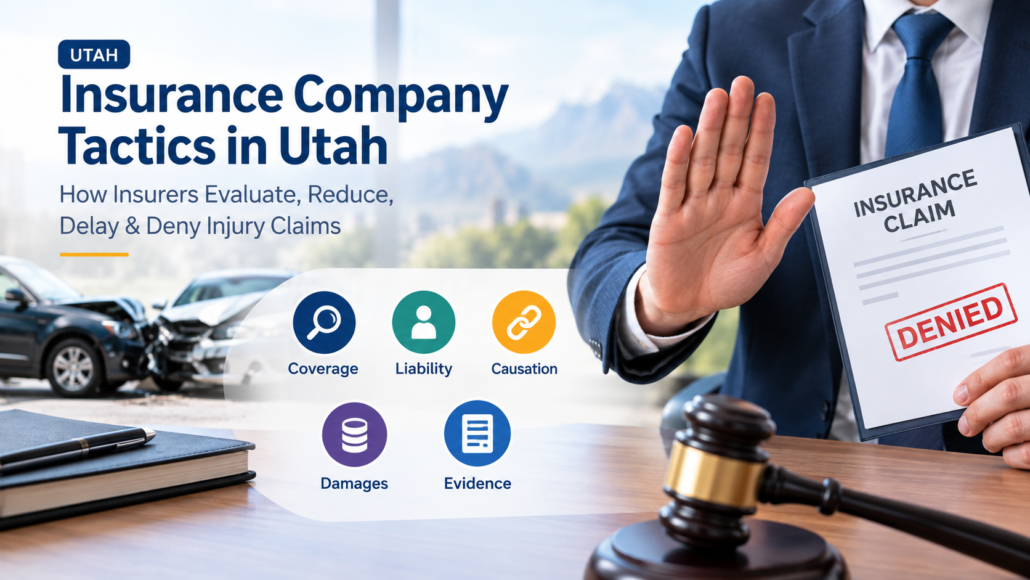
Most personal injury insurance disputes can be traced to many fundamental problems. Here they are:
| What the Insurer Is Examining | The Question Behind It |
| Coverage | Does this insurance policy cover the loss? |
| Liability | Who caused the accident? |
| Causation | Did the accident cause or aggravate these injuries? |
| Damages | What losses resulted from the accident? |
| Evidence | Can those facts and losses be documented? |
For instance, when an adjuster asks about an old back injury, the real problem might be medical causation.
When an adjuster asks about your speed constantly before a crash, the issue might be comparative fault.
As I often tell my injured clients, one of the most helpful steps in the initial phases of the case is identifying the actual objection of the insurer.
Once we are familiar with whether the disagreement involves fault, treatment, damages, coverage, or medical causation, we can determine what evidence truly matters at that point.
Your Insurance Company vs. Someone Else’s Insurance Company
Honestly, this is the most crucial distinction that people tend to overlook.
- A first-party claim includes seeking benefits under your own insurance policy
- A third-party claim includes getting compensation from another person’s insurance coverage.
The Utah Insurance Department also says that the obligations and laws surrounding first- and third-party claims differ.
With your own insurer, you have a contractual relationship governed partly by your policy. With another driver’s insurer, you don’t have that same contractual relationship.
And you know what that means? It signifies that the advice about dealing with the at-fault driver’s adjuster must not be applied automatically to communications with your own insurer.
10 Insurance Company Tactics and Claim Disputes to Watch For
Some of the following are ordinary areas of insurance investigations. Others can become problematic depending on how they are used. You need to understand that difference.
Below, I’ve highlighted the top 10 tactics I have seen insurance companies constantly using on my clients to lower your compensation. Let’s discuss them one by one:
1) Making an Early Settlement Offer
It’s highly common for an insurance company to call you fast (within days) and offer money right away. And to be honest, this one hits super hard.
After all, you’re still in the hospital bed, or perhaps you just got home. You are in pain and misery, and your car is damaged, and suddenly the adjusters call and make an offer.
They may try to become friendly and say something like:
- “Oh, we want to resolve this quickly.”
- “Most people accept this amount gladly.”
- “This is the best offer we made for you.”
At this point, it’ll seem reasonable, even generous to you. But it’s not, believe me.
Because you may not yet know a lot of things, such as:
- Whether symptoms will become chronic later on
- Whether additional treatment will be needed
- Whether future medical care will be suggested
- Whether you can return to your normal job
- How the injury will affect your daily activities
What insurance companies really do here is:
They are trying their hardest to settle before:
- You need imaging (CT/MRI)
- Your symptoms worsen
- You understand limitations/long-term impairment
- Your doctor suggests surgery or injections
And once you sign the release, you can’t demand more money afterwards.
Solution:
Never accept the first lowball offer without first understanding your medical prognosis completely. Also, don’t negotiate based only on today’s bill; keep future care in mind too. Ask for the offer in writing and see how they calculated it.
2) Starting With a Low Settlement Valuation
A low offer and an early offer aren’t always the same.
First offers are just “opening positions” and usually not the fair valuations. In simple words, they are almost 30%-70% below what the case is actually worth.
Because the valuation of the insurer might be lower, as it disputes:
- Some medical treatment
- Lost-income calculations
- Whether all injuries came from the accident
- The severity of the injury
- The claimant’s version of fault
- Possible future damages
That’s why victims are advised to wait until maximum medical improvement and full damages are calculated before making a counter-demand.
Solution:
Rather than responding only that an offer is “too low,” look at why the insurer valued the claim that way. Then, ask your attorney to evaluate your case more deeply and come up with damages calculated in the best way possible.
3) The Recorded Statement Trap
What insurance companies often say to trap accident victims is to ask for a “quick recorded statement.”
Their wording is mostly like this:
- “This helps speed up things.”
- “We only need your file’s version; that’s it.”
Well, don’t trust them.
Because once you allow them to record your statement, there’s no going back.
Potential issues can arise from this, including:
- Describing injuries before doctors even understand them
- Misstating distance or speed accidentally
- Guessing about something you cannot recall
- Minimizing symptoms without realizing
- Making statements inconsistent with evidence
As a result, there’s a possibility that the companies highlight inconsistent details, suggest you are unreliable or unsure, or twist innocent wording into blame admissions.
Solution:
To avoid this, you should politely decline and say, “Sorry, I’m uncomfortable giving a recorded statement at the moment. Please send any questions you’d like in writing.”
Related Post: How to Talk to Insurance Adjusters After a Utah Crash

4) Keeping Early Conversations Friendly and Informal
An adjuster can be courteous, professional, and sound very pleasant in the initial stages. Well, that doesn’t change the adjuster’s role in investigating the claim for the insurer.
No doubt, a casual conversation can still generate information about:
- How the collision occurred
- Current symptoms
- Previous injuries
- Possible fault
- Activities since the accident
Yes, being polite is good, but so is being careful, honest, and accurate.
However, instead, these people tend to make false promises to trap the victims and stop them from hiring an expert car accident attorney.
Solution:
Watch out for the adjuster who tries to befriend you, show up at your place, and promise to cover your future medical bills. Yes, they’ll pay the bills, but only until their computer says, “Oh, too much, too much, it’s costing us too much.” So, beware!
5) Requesting Broad Medical Records or Authorizations
Prior medical information can sometimes be legitimately relevant, especially when similar symptoms or injuries existed before the accident.
Insurers may search for:
- Prior complaints involving the same body part
- Previous accidents
- Degenerative conditions
- Earlier surgeries
- Alternative explanations for symptoms
For that reason, they will send you a HIPAA authorization form & ask you to sign it so they can easily verify all your medical records.
The form they provide you with is usually a blanket authorization that lets them access your whole medical history. Each record from every healthcare provider for years.
And why they want all of it is because they can benefit from digging deeper into your:
- Pre-existing conditions
- Prior accidents
- Mental health history
- Treatments in the past
That way, they use it against you and argue that your condition doesn’t relate to an auto accident. They are fishing.
Solution:
The scope of medical information depends on the claim. A request has to be evaluated to determine what medical problems are relevant and truly answer the dispute. Don’t sign a blanket authorization without having a legal review.
6) Challenging the Necessity or Cost of Medical Treatment
After you have submitted all your medical bills, they will question some of them, and it’s almost inevitable.
So it’s no surprise that these disputes come up with lots of challenges, like:
“Was the treatment medically necessary?”
“Was the amount charged reasonable?”
“Was it caused by the accident?”
Apart from this, they might emphasize that your physical therapy was way “excessive.” Or, the specialist visit was never related, and the MRI was not medically needed, etc.
That’s called IME gaming. There, they send you to a special kind of Independent Medical Examiner (who is paid by them) who says, “You’re just exaggerating.”
Those questions and statements mustn’t be treated as interchangeable. Because evidence supporting one might not resolve another automatically.
Solution:
Your physician’s records carry a lot more weight compared to a one-time IME exam. Therefore, you should get proper notes from your healthcare provider explaining why every treatment was required.

7) Denying Liability
The insurer’s position, sometimes, is straightforward. Its insured didn’t cause the accident.
That makes liability evidence especially important, including:
- Photographs
- Surveillance or traffic video
- Dashcam footage
- Witness accounts
- Police or incident reports
- Physical damage
- Electronic evidence where available
If it never happened to you before, you won’t realize this, but even in cases where the other party’s driver ran a red light, the companies will try their best to find a way to put the fault on you.
They will often claim you were the one not wearing a seatbelt or perhaps speeding and that you were distracted or you had enough time to stop, or whatever.
In Utah and many other states, if you’re 50% or more at fault, you don’t get anything. So bumping your liability share to 40% cuts their payout by 40%.
And by any chance, if they deny liability and it gets approved, you will lose the compensation you deserve.
Solution:
Document everything at the moment. Skin marks, photos of the scene, and damage positions. Collect witness numbers and names, and get the police report. An attorney may send a preservation letter when important evidence could be lost or overwritten.
8) Assigning Some Fault to You
An insurer doesn’t need to deny all liability to affect the claim. It might argue that “the injured person shares responsibility.”
According to the comparative-fault law, fault can be allocated among two or more responsible parties.
That being said, the recovery can be really affected by the claimant’s own percentage of fault, and the statutory framework of Utah prevents recovery where defendants’ combined qualifying fault doesn’t exceed the claimant’s fault.
The Utah Insurance Department summarizes the practical auto-claim rule this way: A claimant should generally be less than 50% at fault to recover from the other driver.
And then, the compensation may be reduced as per the claimant’s percentage of fault.
Solution:
If the insurer is blaming you, you have to be extra careful. Even small factual disputes about right-of-way, visibility, distraction, speed, or evasive action become potentially significant here, and a skilled attorney can be very handy in this matter.
9) Delaying a Claim Decision to Frustrate You
Not all delays are misconduct. But surely some of them are.
Because some insurers do not deny the claim straightaway. They just delay until you feel desperate. For that, here’s what they do:
- Repeatedly ask for documentation
- Transfer your file to new adjusters
- Review medical records for weeks and months
- Ignore emails & force you to call again
In this way, the delays create financial pressure, particularly if you have:
- Car rental costs
- Missed income
- Out-of-pocket prescriptions
- Medical copays
Solution:
When possible, keep all your communications in writing. Save every voicemail and email, and follow up on clear-cut deadlines (“Please respond by Thursday at 6 PM”). It’s also crucial to maintain a claim timeline (names, dates, what was said, etc.)
10) Reviewing Social Media (Yes, Really)
Last but not least, public posts can become evidence potentially.
A caption, photograph, video, check-in, or comment might be examined in connection with allegations about:
- Activities
- Physical limitations
- Emotional effects
- Work and travel
- How the accident occurred
Simply put, insurance companies can review public posts for anything they can use against you, like “feeling better” status updates, photos at gatherings, travel pictures, and gym visits.
Don’t assume that something posted casually will necessarily be interpreted with the same context you intended.
At the same time, people must not conceal or destroy relevant evidence once a dispute exists or litigation is reasonably anticipated.
Solution:
Set all your social media handles to private. Avoid posting about any of your physical activities. Also, ask your friends not to tag you anywhere during your claim, just to be on the safer side.
When Does an Insurance Tactic Become an Unfair Claim Practice in Utah?
Unlawful claim handling or aggressive negotiation aren’t the same. Utah Code §31A-26-303 specifies some particular unfair claim settlement practices.
Among other things, the statute addresses knowing misrepresentations of policy provisions or material facts and specific failures involving instant settlement.
Also, it identifies practices that can qualify as unfair when they’re performed frequently enough to indicate a business practice in general, such as:
- Implement reasonable investigation standards
- Acknowledge claims promptly
- Explain denials or compromise offers reasonably
- Pursue fair settlement where liability is pretty clear
Utah Administrative Rule R590-190 provides additional detail. Among the practices it addresses are:
- Discouraging a claimant from obtaining an attorney
- Refusing payment without enough investigation
- Requiring specific broad releases
- Misleading a claimant about a statute of limitations
- Specified delayed-payment practices
- Refusing to provide an insured with a written basis for denial upon demand
There’s a crucial legal qualification: Utah Code §31A-26-303 itself highlights that it doesn’t create any private cause of action itself.
Whether other remedies exist or not depends totally on the relationship between parties, the conduct involved, the applicable law, and policy.
How Long Can an Insurance Company Investigate a Claim in Utah?
The rules in Utah provide helpful benchmarks, but they don’t mean every personal injury claim has to settle within only 15-30 days, or so.
In general, here’s what the timeline looks like:
- 15 Days → Acknowledge notice of loss, subject to specified exceptions.
- 15 Days → Provide a substantive response whenever one is requested.
- 30 Days After Complete Proof of Loss → Investigate & accept or deny qualifying first-party claims unless the investigation requires more time.
- 45-Day Updates → Additional written explanations might be required for specific unresolved first-party investigations, with exceptions involving represented claimants.
Those are claim-handling requirements, not promises that a whole disputed injury case will conclude on those dates.
What Should You Ask When an Insurance Company Denies or Reduces Your Claim?
When I see a disputed claim, I want to move beyond “the offer is too low” or “they denied it.”
I want to know why.
Ask:
- What part of the claim is being disputed precisely?
- What evidence or documents were relied upon?
- What facts support that position?
- What additional evidence would affect the evaluation materially?
- If coverage is denied, what condition, policy provision, or exclusion is the basis?
For qualifying first-party claims, the rules in Utah require the basis for denial to be communicated and documented in writing, and a denial based on a specific condition, exclusion, or provision must reference it.
That gives you something solid to evaluate rather than arguing against a vague “no.”
What Evidence Can Help Answer Insurance Company Arguments?
The strongest evidence relies on what’s exactly being challenged.
If Fault Is Disputed:
- Accident photographs
- Videos
- Witnesses
- Police/incident reports
- Physical damage
- Electronic evidence
If Medical Causation Is Disputed:
- Initial treatment records
- Symptom chronology
- Diagnostic imaging
- Relevant prior records
- Treating-provider documentation
If Damages Are Disputed:
- Medical bills
- Wage records
- Employer verification
- Receipts
- Work restrictions
- Evidence of functional limitations
If Claim Handling Is Disputed:
- Emails
- Letters
- Claim numbers
- Adjuster names
- Dates of calls
- Document submissions
- Settlement offers
- Denial letters
One principle I strongly believe in is that more paperwork doesn’t always mean stronger evidence. And for you, the most precious evidence is the one that answers the specific objections of your insurer.
Can an Insurance Company Delay Until Your Filing Deadline Expires?
Continuing negotiations shouldn’t be treated as permission to ignore a legal deadline.
Utah’s R590-190 contains an essential protection, i.e.,
“When settlement negotiations continue with specific unrepresented third- or first-party claimants, the insurer has to notify the claimant of the applicable statute of limitations or other time limit a minimum of 60 days before it expires.”
Don’t depend on that provision as your whole deadline-management system.
Different cases can include different deadlines, especially claims that involve special circumstances or governmental entities.
What Should You Do If an Insurance Claim Starts Going Wrong?
If that happens, you should use a structured approach. Here are the steps I recommend the victims follow:
Step 1. Identify the insurer: Is it the other party’s or yours?
Step 2. Now, identify the dispute. Liability, damages, coverage, or evidence?
Step 3. Get the most important positions in writing.
Step 4. Maintain a claim timeline of submissions, communications, offers, & responses.
Step 5. Go the extra mile to preserve all the relevant evidence.
Step 6. Independently determine applicable deadlines.
Step 7. Consider whether the dispute needs legal review or escalation.
Still, if an insurance issue doesn’t seem to get resolved directly, the Utah Insurance Department accepts complaints, including those involving casualty and property insurers.
What happens is that the department forwards complaints for a response, reviews that particular response, and provides its findings.
Insurance Company Tactics: Quick Reference
| If the Insurer Says or Does This | The Underlying Issue May Be |
| “You were partly responsible.” | Comparative fault |
| “You already had this condition.” | Medical causation/aggravation |
| “You received too much treatment.” | Necessity/damages |
| “You waited too long to seek care.” | Causation/severity |
| “We need additional records.” | Evidence/causation |
| “This loss isn’t covered.” | Insurance coverage |
| “This is our final offer.” | Claim valuation |
| “Repeated unexplained delay” | Claim handling/investigation |
The common thread is simple: just find the disputed problem first, then determine what Utah law and evidence apply to it.
Understand the Dispute Before You Resolve the Claim
No doubt, insurance company tactics can be really frustrating, especially for those dealing with them for the first time in their lives.
But you know what? The most productive response typically starts by identifying exactly what the insurer is challenging.
Is it coverage? Fault? Treatment? Lost income? Medical causation? The value of the injuries?
Once that question is answered, the legal issues and evidence become much clearer.
At Cockayne Law, we help injured residents in Utah examine their evidence, medical documentation, insurance coverage, disputed issues, and Utah law so they can understand their options better.
If another person’s negligence caused your injuries and an insurance dispute is seriously complicating your claim, a consultation can clarify what the insurer is up to.
Contact us to talk about what steps may be available next and how to deal with it in the best way possible!

Chris Cockayne is a Utah-based personal injury attorney and the founder of Cockayne Law. Chris focuses exclusively on representing victims of car accidents, dog bites, and other injury claims, helping clients recover compensation for medical bills, lost wages, and long-term care. With over 15 years of legal experience, Chris has handled a wide range of personal injury and motor vehicle accident cases and is known for his client-focused advocacy and strong negotiation with insurance companies. Know more about Chris Cockayne or my other social profiles like Avvo | Martindale | lawyers | Findlaw | Yelp | lexinter | Linkedin | Facebook | and X